Molecular Biology Group
Functional Analysis of the Multifunctional Protein Praja1
Overview
In the Molecular Biology Group, we conduct research aimed at understanding life at the molecular level through the functional analysis of proteins, the cellular workers. Currently, our focus is on a protein called Praja1, possessing two distinct molecular functions.
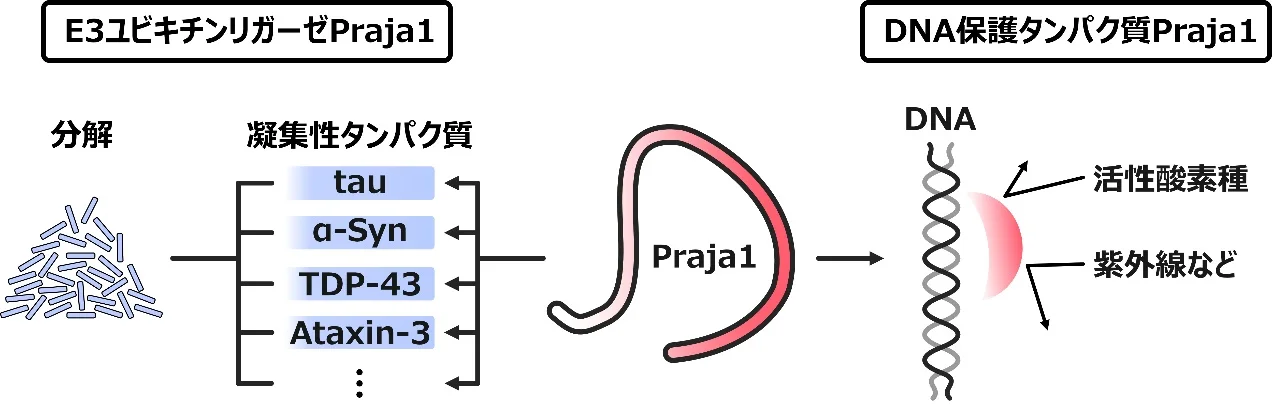
Praja1 functions both as an “E3 ubiquitin ligase,” which recognizes and directs the degradation of unwanted proteins, and as a “DNA-protective protein” that safeguards nuclear DNA from damage. Our research comprehensively examines both of these aspects.
Praja1 as an “E3 ubiquitin ligase”
Protein expression in living organisms is strictly regulated in terms of when, where, and how much is expressed. Among the enzymes involved in this process, E3 ubiquitin ligases (E3 enzymes) are known to direct the degradation of proteins that are no longer needed. Inadequate E3 enzyme activity is thought to lead to the accumulation of toxic protein waste, which in turn links to disease onset and aging.
Since Praja1 broadly recognizes and degrades aggregating proteins commonly found in neurodegenerative diseases (such as α-synuclein, TDP-43, and FUS), it is suggested to play a suppressive role in the onset and progression of these diseases. Our research has revealed that Praja1 also recognizes and degrades Tau protein, which aggregates in neurodegenerative diseases such as Alzheimer’s disease1. We are currently exploring the interaction between Praja1 and Tau in greater depth. Additionally, collaborating with the electrochemistry group within our laboratory, we are developing biosensors utilizing Praja12.
Praja1 as a “DNA-protective protein”
Intracellular DNA is damaged daily by various factors. In addition to internal factors such as reactive oxygen species generated by metabolic activity within the body, it is also exposed to external factors such as ultraviolet radiation and radiation therapy for cancer. Furthermore, the cosmic rays that humans are exposed to during space travel can damage DNA, which will pose a challenge in the future as humanity seeks to improve its quality of life in space (space QOL).
Through molecular evolutionary analysis, we discovered that Praja1 acquired the ability to localize to the cell nucleus during the evolution of mammals3. Furthermore, while investigating the physiological role of Praja1 after its entry into the nucleus, we obtained a novel finding—previously unreported—that Praja1 protects DNA4. We are currently working to elucidate the molecular mechanisms by which Praja1 exerts its DNA-protective effects.
Related Publications
- [1] Shiho Aoki✞, Wataru Onodera✞,※, Akihiko Takashima, Kotaro Kawasaki, Kazuki Imadegawa, Hikaru Kurahashi, Mizuho Oishi, Toru Asahi, Yoshiyuki Soeda. E3 ligase Praja1 mediates ubiquitination and degradation of microtubule-associated protein tau. The FEBS Journal. 293(8): 2212-2224. (2025)
✞ Shiho Aoki and Wataru Onodera equally contributed to this work.
※ Corresponding author
This paper was selected as an Editor’s Choice article. - [2] Wataru Mori, Wataru Onodera, Terutoshi Kojima, Toru Asahi※, Takuya Nakanishi※. Interaction between intrinsically disordered proteins Praja1 and α-synuclein on gold electrodes. Chemistry Letters. 53(11):upae205. (2024)
※ Corresponding author - [3] Wataru Onodera✞,※, Kotaro Kawasaki✞, Mizuho Oishi, Shiho Aoki, Toru Asahi※. Functional Divergence and Origin of the Vertebrate Praja Family. Journal of Molecular Evolution. 92:21-29. (2024)
✞ Wataru Onodera and Kotaro Kawasaki contributed equally to this work.
※ Corresponding author - [4] Kotaro Kawasaki, Toru Asahi, Wataru Onodera※. Praja1 protects cells from DNA damage through direct DNA binding. bioRxiv. https://doi.org/10.64898/2025.12.04.691747 (2025)
※ Corresponding author