In recent materials research, the amount of data obtained from experiments and calculations has been increasing rapidly. However, the discovery of new materials still requires extensive trial and error. It remains difficult to identify promising materials and conditions from a vast number of candidates.
Materials Informatics (MI) is a research field that integrates materials science and information science. It aims to make materials development more efficient and advanced by using machine learning and optimization techniques. In our group, we combine crystal structure prediction, machine learning, first-principles calculations, and quantum computing techniques to explore new materials and predict their properties.
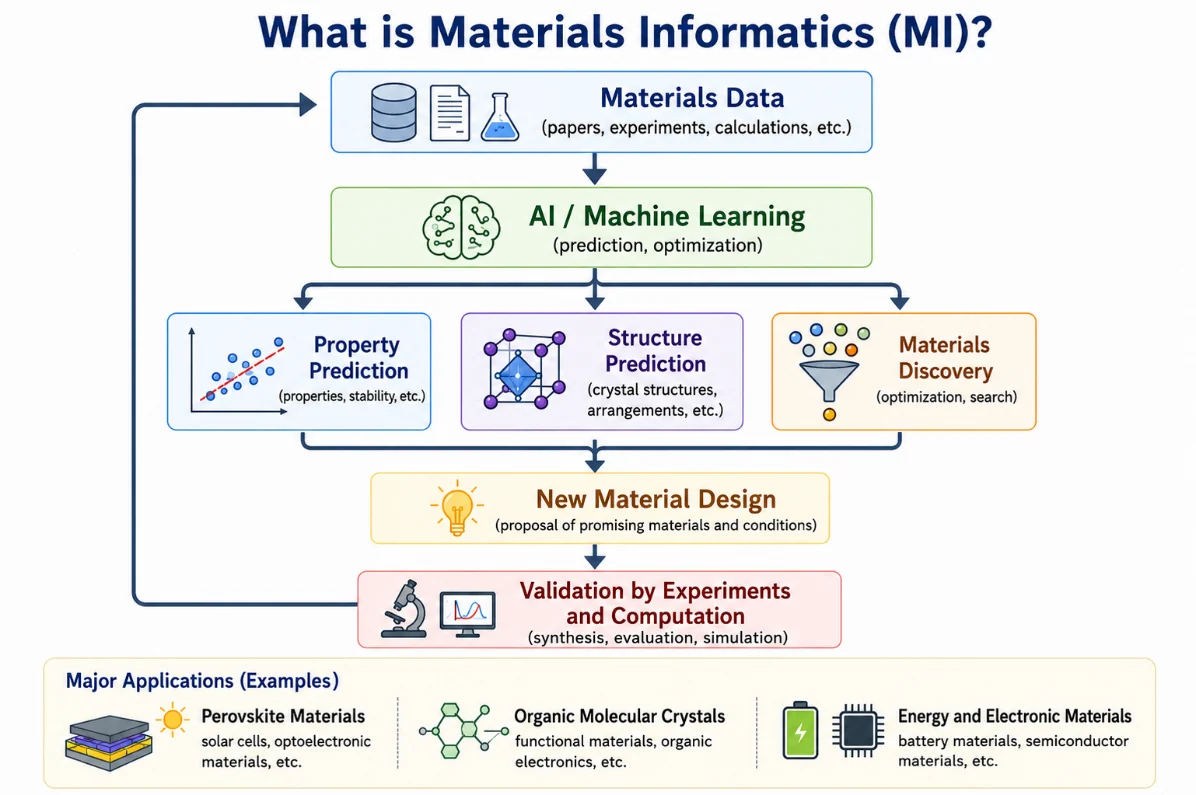
Figure 1 What is materials informatics?
Data Driven Research on Perovskite Solar Cells
Perovskite solar cells have attracted attention as next generation solar cells that are expected to achieve both high power conversion efficiency and low cost fabrication. However, their performance and durability are strongly affected not only by material composition, but also by fabrication conditions and device structures.
Our group uses experimental data and literature data reported by researchers around the world to predict device performance and evaluate stability using machine learning. [1] In addition, we aim not only to make predictions, but also to understand the factors that affect performance and durability through model interpretation. [2]
![Figure 2. Data driven research on perovskite solar cells. Based on [1].](/img/fig/research/groups/mi-figure-2-en.webp)
Figure 2. Data driven research on perovskite solar cells. Based on [1].
Crystal Structure Prediction of Perovskite Materials
Material properties are strongly affected not only by chemical composition, but also by the arrangement of atoms and molecules. In particular, in organic inorganic hybrid perovskites, the orientation of organic molecules and differences in crystal structures are known to have a significant influence on material properties.
Our group is developing efficient crystal structure prediction methods for perovskite materials by using crystal structure search algorithms, machine learning potentials, first principles calculations, and annealing machines. [3] We also investigate structure candidates that are difficult to observe by experiments alone through computational approaches, aiming to apply the obtained knowledge to materials design.
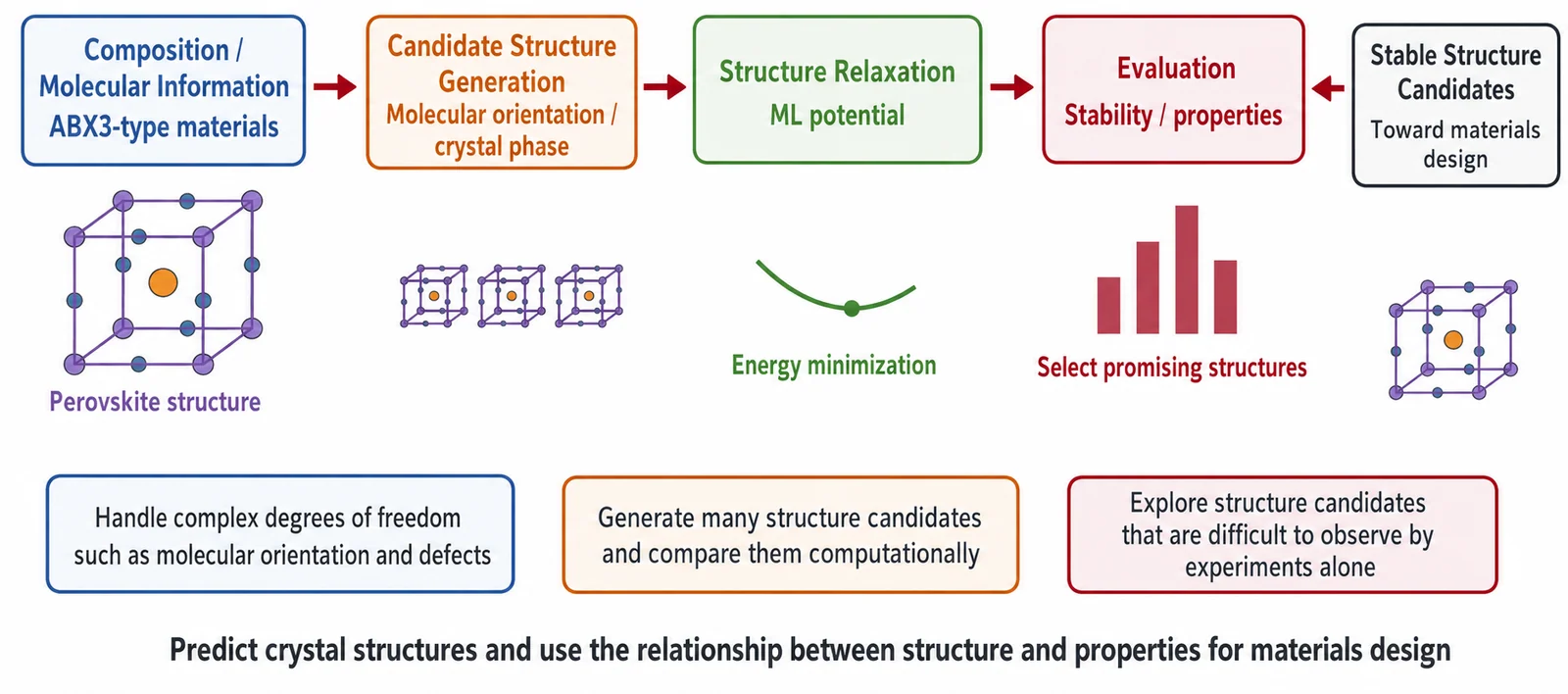
Figure 3. Crystal structure prediction of perovskite materials.
Crystal Structure Prediction and Property Design of Organic Molecular Crystals
In organic molecular crystals, even crystals formed from the same molecule can show large differences in optical properties, electronic properties, stability, and other properties, depending on molecular arrangement and crystal structure.
Our group explores stable structures of organic molecular crystals using crystal structure prediction techniques. We also analyze the relationship between the obtained crystal structures and their properties, aiming to establish design guidelines for new functional materials.
![Figure 4. Crystal structure prediction and property design of organic molecular crystals. Based on [4].](/img/fig/research/groups/mi-figure-4-en.webp)
Figure 4. Crystal structure prediction and property design of organic molecular crystals. Based on [4].
Materials Exploration Using Machine Learning and Optimization Techniques
In materials development, there are many variables, such as composition, crystal structure, and fabrication conditions. Therefore, finding optimal materials becomes a large scale search problem.
Our group develops more efficient methods for materials exploration by using machine learning, Bayesian optimization, annealing, and other optimization techniques. By applying these techniques to crystal structure prediction and materials design, we aim to realize the next generation of data driven materials research.
In addition to perovskite materials and organic molecular crystals, our group studies a wide range of materials, including energy materials, electronic materials, and functional materials. [5-9] Through industry academia collaboration and joint research, we are working to establish new methods for materials development based on computational science and data science.
Asahi Laboratory Publications
- [1] R. Fukasawa, T. Asahi and T. Taniguchi. Effectiveness and limitation of the performance prediction of perovskite solar cells by process informatics. Energy Advances, 2024, 3, 812-820.
- [2] T. Taniguchi, R. Fukasawa and T. Asahi. Optimization of fabrication conditions for perovskite thin films using machine learning. In Data Analysis, Modeling, and Applications in Process Informatics, Technical Information Institute Co., Ltd., 2025, 405-411. [in Japanese, title translated]
- [3] R. Fukasawa. Development of software for perovskite crystal structure search using quantum annealing. Information Technology Promotion Agency, Japan, MITOU Target Program, Achievement Report. Report
URL: https://www.ipa.go.jp/jinzai/mitou/target/2025/rcu1hd000000pjci-att/seikashosai-ts-3.pdf.
Published on May 22, 2026. [in Japanese, title translated] - [4] T. Taniguchi and R. Fukasawa. Crystal structure prediction of organic molecules by machine learning-based lattice sampling and structure relaxation. Digital Discovery, 2025, 411, 3270-3281.
- [5] K. Ishizaki, R. Sugimoto, Y. Hagiwara, H. Koshima, T. Taniguchi and T. Asahi. Actuation performance of a photo-bending crystal modeled by machine learning-based regression. CrystEngComm, 2021, 23(34), 5839-5847.
- [6] D. Takagi, K. Ishizaki, T. Asahi and T. Taniguchi. Molecular screening for solid-solid phase transitions by machine learning. Digital Discovery, 2023, 2(4), 1126-1133.
- [7] K. Ishizaki, D. Takagi, T. Asahi, M. Kuramochi and T. Taniguchi. Unraveling the structural and property differences between highly similar chiral and racemic crystals composed of analogous molecules. Crystal Growth & Design, 2023, 23(7), 5330-5337.
- [8] K. Ishizaki, T. Asahi and T. Taniguchi. Machine learning-driven optimization of the output force in photo-actuated organic crystals. Digital Discovery, 2025, 4(5), 1199-1208.
- [9] T. Taniguchi, K. Ishizaki and R. Fukasawa. Accelerating Discovery of Organic Molecular Crystals via Materials Informatics and Autonomous Experiments. Advanced Intelligent Discovery, 2026, e70124.