Computational Biology Group
Elucidating Tissue 3D Architecture and Brain Vascular Aging with Public Data
Overview
In the Computational Biology Group, we use computational science to read out the rapidly expanding body of public gene-expression data and to reveal, at scale, how tissues are organized and how they are remodeled with aging and disease. Our particular focus is developing analysis tools for spatial transcriptomics, which measures where in a tissue gene expression occurs while preserving location, and connecting this to the understanding of tissues such as the brain vasculature. We pursue this question with two wheels turning together, large-scale dry analysis and experimental (wet) validation through collaboration, and we also develop the computational tools this requires (Figure 1).
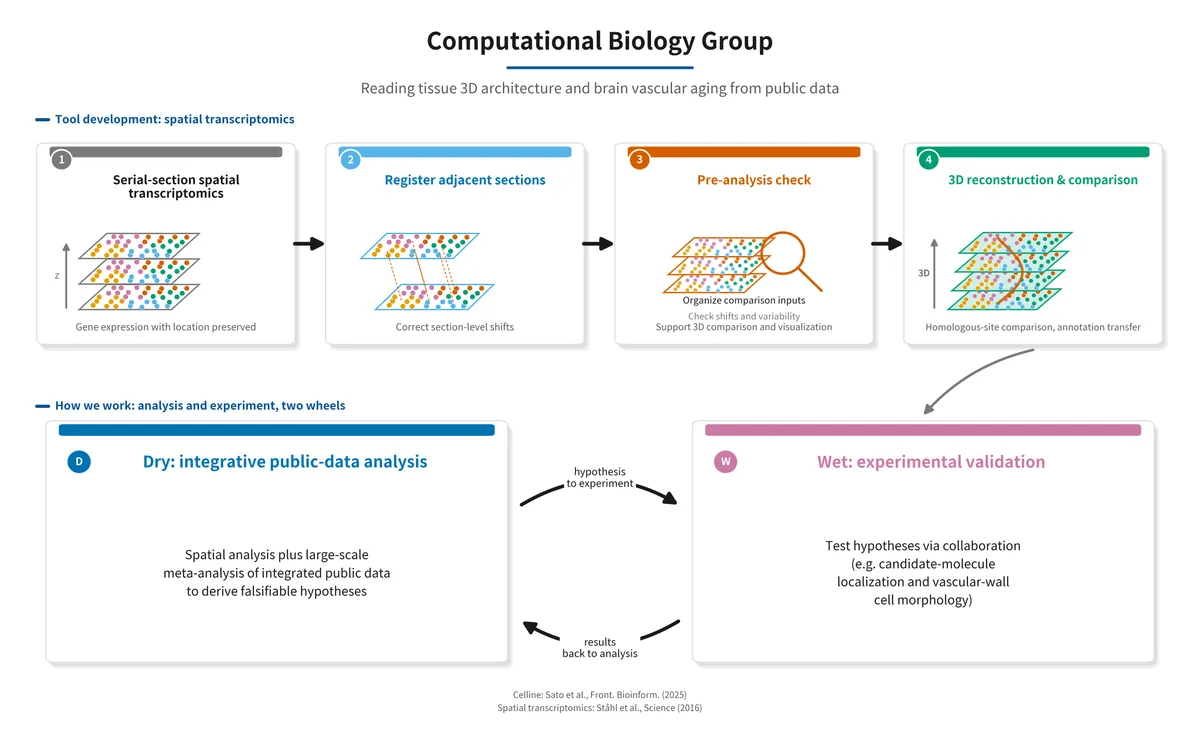
Figure 1. Overview of the Computational Biology Group. We develop a tool that aligns serial-section spatial transcriptomics for comparing and visualizing tissue 3D architecture. Around this, we support 3D reconstruction, homologous-site comparison, and annotation transfer. Together with large-scale meta-analysis built on public-data integration foundations, falsifiable hypotheses from dry analysis are tested by experiment (wet) through collaboration, and the results feed back into the analysis, forming a two-wheel cycle.
Reading tissue 3D architecture from spatial transcriptomics
Spatial transcriptomics measures where in a tissue gene expression occurs while preserving location, and it has been transforming the life sciences in recent years [1]. However, a single experiment usually yields one thin section (a 2D slice). To study the 3D architecture that the tissue actually has, or to compare the same anatomical region across samples, serial sections must be organized computationally while accounting for section-level shifts and data variability.
The tool we are currently developing is a computational foundation for comparing and visualizing tissue 3D structure from serial sections. It organizes the data into a form that supports 3D reconstruction, homologous-site comparison, and annotation transfer while taking section-level shifts and variability into account. We are currently checking its behavior on public datasets and organizing the evaluation for broader applications.
Foundations for integrating public data
Large-scale meta-analysis requires a foundation for retrieving, standardizing, and integrating public data scattered across repositories such as GEO and SRA. Within the group, we have built public-data integration foundations such as Celline [5], which executes this whole sequence with a single-line command. With these, we can, for example, integrate many public human-brain single-nucleus RNA-seq datasets and build cell-type-specific indices of aging. Combined with spatial-transcriptomics analysis, this lets us approach how the brain vasculature changes along both its 3D architecture and its aging.
Dry and wet: two wheels turning together
What computational analysis provides is, in the end, a falsifiable hypothesis. We therefore emphasize a two-wheel system in which these hypotheses are tested through collaboration with experimental groups. For example, by analyzing public vascular data across several species, we extract candidate molecules and phenotypes related to endothelial and vascular-wall cells. We are now proposing selected candidates to vascular-biology collaborators as experimental protocols to test localization and function. Likewise, we are looking ahead to experimental validation and collaboration on age-related changes in vascular-supporting cells. By confirming computational predictions through experiment and feeding the results back into analysis, we aim to depict how the brain vasculature and other tissues age and progress toward disease.
What we aim for
Developing analysis tools that read tissue structure and change from public data, including spatial transcriptomics, performing large-scale analysis with them, and validating predictions experimentally: by uniting these three elements, we aim to clarify how the brain vasculature changes along both its 3D architecture and its aging, and to openly share the tools we develop with the community. This is the goal of the Computational Biology Group.
References
- [1] Ståhl PL, et al. Visualization and analysis of gene expression in tissue sections by spatial transcriptomics. Science 353: 78–82 (2016).
- [2] Vanlandewijck M, et al. A molecular atlas of cell types and zonation in the brain vasculature. Nature 554: 475–480 (2018).
- [3] Yang AC, et al. A human brain vascular atlas reveals diverse mediators of Alzheimer's risk. Nature 603: 885–892 (2022).
- [4] Montagne A, et al. Blood-brain barrier breakdown in the aging human hippocampus. Neuron 85: 296–302 (2015).
Related Publications
- [5] Sato Y, Asahi T, Kataoka K. Celline: a flexible tool for one-step retrieval and integrative analysis of public single-cell RNA sequencing data. Front. Bioinform. 5: 1684227 (2025).